Remote ID awareness
See the drones in your airspace.
When a drone is over your site, your people should know where it’s flying and where the pilot is — so they can do something about it. One live map, whether that site is a campus, a fire, a plant, or a packed stadium.
The problem
You already patrol the ground, but who is watching your sky?
When a drone flies over a restricted area, a sensitive plant, or a stadium, your team is working without a clear picture of the airspace. Most U.S. drones already broadcast Remote ID — an FAA-mandated tracking beacon, the drone equivalent of ADS-B. Drone-Mapper is how you receive that beacon and put the aircraft and the pilot on a live map.
Who it’s for
Drone-Mapper is built for the future; we’re here to help yours!
01 / 6
How it works
What you buy
Everything you need for one site.
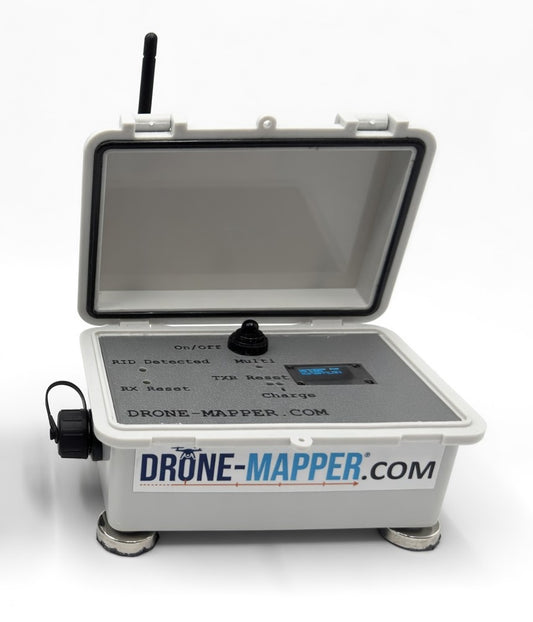
A gateway and one detector are enough to start. They see every Remote ID aircraft and its pilot. Add detectors as you cover more of the property — extra detectors on the same site do not raise the software price.
Additional Gateway (Drone-Mapper™ Web Service)
$490.00
View listing →
Additional Remote Detector
$649.00
View listing →
Additional WiFi Gateway
$549.00
View listing →
Drone-Mapper™ Web Service
$1,490.00
View listing →
Managed Satellite Internet Connectivity
$1,188.00
View listing →
Satellite Internet Hardware for Drone-Mapper™
$499.00
View listing →
FAQ
What to know before you buy.
What does this actually detect? +
Drones that broadcast Remote ID - an FAA-mandated tracking beacon most U.S. drones already send while they fly. Same idea as ADS-B on manned aircraft. You see the aircraft and the pilot location on a live map.
Is this radar or a jammer? +
Neither. It listens. If a drone is not broadcasting Remote ID, it will not appear. That honesty is the point: you get a clear picture of compliant traffic, not a magic shield.
What do I buy to start? +
Starter Kit plus Web Service. One gateway, one detector, a hosted map. Add remotes later without a software overage.
How many detectors do I need? +
Height beats count. A small site often starts with the kit, both units mounted high. A campus typically grows to 2-4 remotes. Add boxes for measured gaps - not anxiety.
What if the site has no internet? +
The gateway needs a path out. If Wi-Fi is not an option, add Managed Starlink. People watching the map use their own internet.